Data and IO
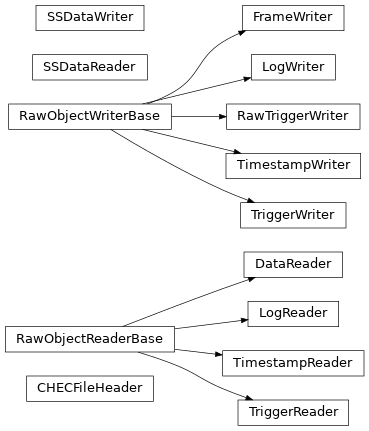
This section presents the classes used to read and write data that is acquired by the SSDAQ system. Data is written using two file formats; slow signal data received from the camera is written to hard drive using the hdf5 fileformat, while all other data use the custom indexed container format (icf) using their on wire formats for serialization.
In general, to read data the DataReader handles all data except for
slow signal data which can be read using SSDataReader.
ssdaq.data.io
-
class
ssdaq.data.io.DataReader(filename: str)[source]¶ -
__init__(filename: str)[source]¶ Open a Streamed Object File to read.
Parameters: filename (str) – path and filename Raises: ValueError– Is raised if no suitable unpacker is found
-
close()¶ closes file handle
-
filesize¶ the file size on disk in bytes
Returns: file size Return type: int
-
n_entries¶ number of objects in file.
Returns: file object count Return type: int
-
read()[source]¶ Reads one object at the position of the file pointer.
Returns: Bytes that represent the object Return type: bytes
-
read_at(ind: int)[source]¶ Reads one object at the index indicated by ind
Parameters: ind (int) – the index of the object to be read Returns: that represent the object Return type: bytes Raises: IndexError– if index out of range
-
reload()¶ Reload the index table. Useful if the file is being written too when read
-
resetfp()¶ Resets file pointer to the first object in file
-
timestamp¶ unix timestamp of the file creation time
Returns: creation datetime Return type: datetime.datetime
-
-
class
ssdaq.data.io.SSDataReader(filename, mapping='ssl2asic_ch')[source]¶ A reader for Slow Signal data
-
__init__(filename, mapping='ssl2asic_ch')[source]¶ Parameters: filename (str) – path to file - Kwargs:
- mapping (str): determines how the pixels are mapped. Two mappings
- are availabe: ‘ssl2colrow’ and ‘ssl2asic_ch’ which correspond to a 2D col-row layout and ASIC-channel which is the same ordering used for the fast signal data.
-
load_all_data(tm, calib=None, mapping=None)[source]¶ Loads all rows of data for a particular target moduel into memory (in the future a selection of modules)
Parameters: tm (int) – The slot number of the target module - Kwargs:
calib (arraylike): an array with calibration coefficient that should be applied to the data mapping (str or arraylike): a string to select a mapping or an array with the mapping
[‘ssl2colrow’,’ssl2asic_ch’,’raw’]
-
-
class
ssdaq.data.io.SSDataWriter(filename: str, attrs: dict = None, filters: tables.filters.Filters = None, buffer: int = 1000, tel_table=True)[source]¶ A writer for Slow Signal data
ssdaq.core
-
class
ssdaq.core.io.RawObjectWriterBase(filename: str, protocol: int = 1, compressor='bz2', **kwargs)[source]¶ Base class of a file object for writing indexable chunks of serialized data to file.
-
__init__(filename: str, protocol: int = 1, compressor='bz2', **kwargs)[source]¶ Summary
Parameters: - filename (str) – Description
- protocol (int, optional) – Description
- compressor (str, optional) – Description
- **kwargs – Description
-
data_counter¶ Counter of the number of objects written to file
Returns: int
-
-
class
ssdaq.core.io.RawObjectReaderBase(filename: str)[source]¶ This class
Variables: - file (TYPE) – Description
- filename (TYPE) – Description
- metadata (dict) – Description
-
__init__(filename: str)[source]¶ Reads Streamed Object Files
Parameters: filename (str) – filename and path to the file Raises: TypeError– Raised if the file is not recognized as SOF
-
filesize¶ the file size on disk in bytes
Returns: file size Return type: int
-
n_entries¶ number of objects in file.
Returns: file object count Return type: int
-
read() → bytes[source]¶ Reads one object at the position of the file pointer.
Returns: Bytes that represent the object Return type: bytes
-
read_at(ind: int) → bytes[source]¶ Reads one object at the index indicated by ind
Parameters: ind (int) – the index of the object to be read Returns: that represent the object Return type: bytes Raises: IndexError– if index out of range
-
timestamp¶ unix timestamp of the file creation time
Returns: creation datetime Return type: datetime.datetime
Fileformat Protocols
Both the custom protocols used by the RawObjectWriterBase and
RawObjectReaderBase are indexed containers meaning that they just
provide the framework and file format to index objects that are written to file. Methods of
serializing and deserializing the objects must be provided to these classes.
protocol 0
This protocol provides a basic format for indexing objects. However, it has limitations as there is no efficient way of compressing the data saved in this format unless the whole file is compressed. The protocol is defined as:
Data chunks of serialized data are
sequentially writter to file, with
each chunk being prepended with:
chunk length in bytes (4 bytes)
and a crc32 hash      (4 bytes)

The file header is 24 bytes long and has the following layout

    bytes:      field:
    0-7         Custom field for file format specifications (set by the header parameter)
    8-11        Protocol version
    12-15       Not used
    16-19       Not used
    20-23       Not used

General file structure:
    +-------------+
    | File Header |
    +-------------+
    | Chunk Header|
    +-------------+
    |     Data    |
    +-------------+
    | Chunk Header|
    +-------------+
    |     Data    |
    +-------------+
          ...
          ...
protocol 1
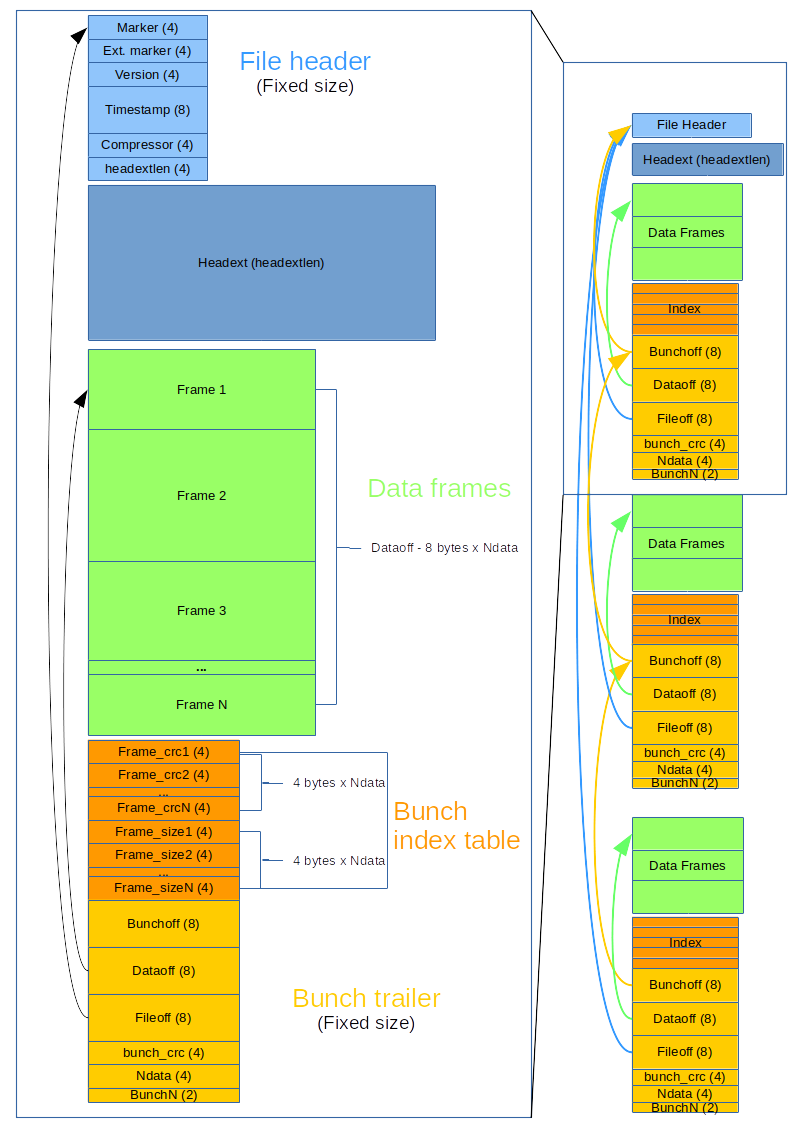
Protocol 1 is more complicated than protocol 0 as it supports compression, includes a filecreation timestamp (redundancy of the unix timestamp which can be accidentally changed while copying) and an extendible header which can be used by custom formats to store meta-data. The protocol is defined as:
Code structure